How is the Chief Justice appointed in Nepal: A Look at Nepal’s Most Powerful Robe
Explore how Nepal appoints its Chief Judge, the constitutional process involved, and why the role holds immense legal and political influence.

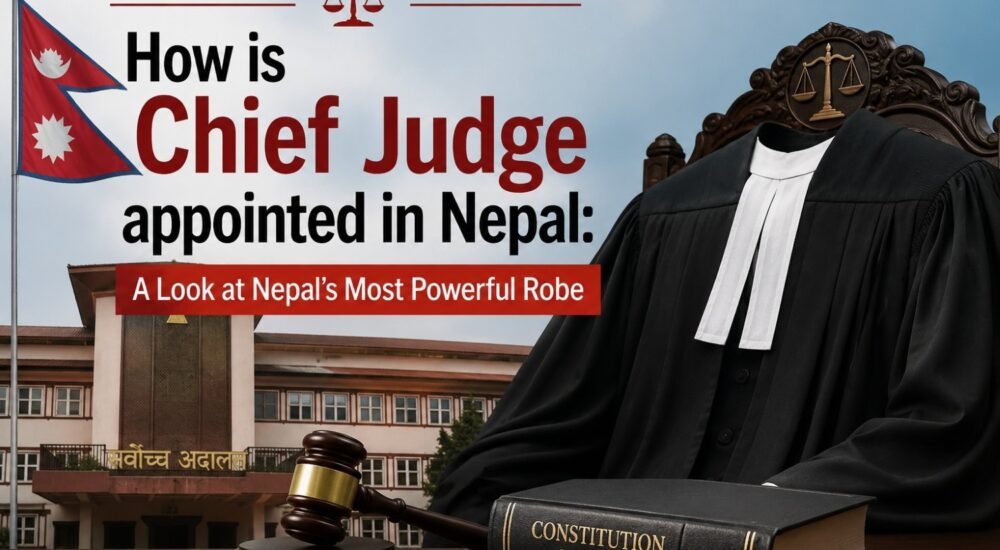
The Chief Justice of Nepal is the main judge and leader of Nepal’s highest court. Constitutional Council, a constitutional body responsible for recommending individuals for the appointment of key constitutional positions, recommends candidates for the appointment in the position of Chief Justice. The Chief Justice also includes any acting Chief Justice who performs temporary duties of Chief Justice. This article examines the constitutional and legal basis for the appointment of the Chief Justice of Nepal, legal basis of seniority rule, meritocracy (ability-based selection) and hark look review (careful checking) and compares the appointment process with those of other countries in the world to see if Nepal’s approach protects judicial independence.
Legal Basis of Appointment of the Chief Justice
The Constitution of Nepal is the primary law for appointing the Chief Justice. Several other supplementary laws also guide the process. The Judicial Council Act, 2073 (2016) covers the candidate list, the Constitutional Council (Functions, Duties, Powers, and Procedures) Act, 2066 (2009) and the Good Governance (Management and Operation) Act, 2064 (2008) set rules for evaluation and recommendation. Public vetting and final approval occur under the Federal Parliament’s Joint Sitting and Joint Committee (Conduct of Business) Rules, 2075. Based on this legal hierarchy, the core appointment process is mentioned below:
Who can become the Chief Justice in Nepal?
According to Article 129(3) of the Constitution of Nepal (2072), only a person who has served as a Supreme Court Judge for at least 3 years is eligible to become Chief Justice. Under Article 129(5) of Constitution of Nepal (2072), to be appointed as a Judge of the Supreme court, one should have the following qualifications:
- Nepali citizen with a bachelor’s degree in law.
- Served as the Chief Judge or a Judge of a High Court for at least five years.
- Law degree with at least fifteen years of continuous practice as an advocate or senior advocate.
- At least fifteen years of continuous work as a distinguished jurist in legal or judicial field.
- At least twelve years of service in the post of Gazetted first class or a higher post of the Judicial Service.
Article 129(6) provides that the seniormost judge becomes the Acting Chief Justice if the position is vacant, making seniority the key criterion for appointments which states that the longest serving associate justice of the Supreme Court has a rightful expectation of automatically becoming Chief Justice.
However, Constitution of Nepal has not explicitly mentioned the specific criteria for selection of the Chief Justice leaving the Constitutional Council with broad discretion under Article 284 while making its recommendation. This allows Chief Justice to be selected for their leadership, administrative skills, and plans for judicial reform, not just for their years of service with proper clarification.
Vacation and Tenure of the office of the Chief Justice
Under Article 131 of the Constitution of Nepal (2072), the office of Chief Justice becomes vacant in the following circumstances:
- The Chief Justice gives written resignation to the President.
- Attains the age of sixty-five years.
- Removal through impeachment under Article 101(2).
- Unable to discharge duties because of physical or mental illness.
- Punished by a court for a criminal offence involving moral turpitude.
- Death while in the office.
Under Article 129(4), the tenure of the Chief Justice in Nepal is six years.

Appointment process of Chief Justice in Nepal
The legal and constitutional basis for the appointment of Chief Justice in Nepal is mentioned below:
Acting Chief Justice Steps in as vacancy arises
When the office of the Chief Justice becomes vacant, the senior most judge of the Supreme Court becomes the Acting Chief Judge automatically and carries all the duties and functions as the Chief Justice under Article 129(6) of the Constitution of Nepal (2015) and Section 2(b) of the Supreme Court Act 1991.
Judicial Council makes the List
The Judicial Council is established as the main body that advises and makes recommendations regarding the appointment, transfer, dismissal, and discipline of all District, High and Supreme Court judges except for recommendation in the appointment of Chief Justice. It also oversees other aspects of judicial administration and consists of following members:
- The Chief Justice as Chairperson
- The Federal Minister for Law and Justice
- Senior most Judge of the Supreme Court
- One jurist nominated by the President on recommendation of the Prime Minister
- A senior advocate or advocate with twenty years of experience, recommended by the Nepal Bar Association and appointed by the President.
When the office of the Chief Judge is vacant, the Judicial Council under Article 153 of the Constitution of Nepal (2015) and Section 33 of the Judicial Council Act 2016,prepare the updated records and identifies the persons qualified for the appointment to offices of the Chief Justice, Judges of the Supreme Court, Chief Judges and Judges of High Court.
The Constitutional Council Meets and Recommends
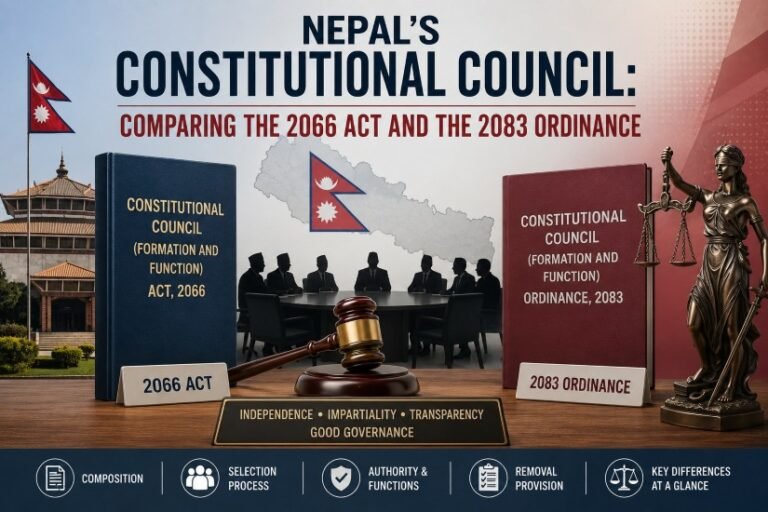
The Constitutional Council, established under Article 284(1) of the Constitution of Nepal 2015, is responsible for recommending the Chief Justice. The Council includes six members:
- The Prime Minister as Chairperson
- The Speaker OF House of Representatives
- The National Assembly Chairperson,
- The Opposition Leader,
- The Deputy Speaker, and
- The Chief Justice.
The Minister for Law and Justice of the Government of Nepal as an additional member joins the Constitutional Council for the recommendation of the Chief Justice before one month of the vacation of the office under Article 284(2) and (3).
According to the Constitutional Council (First Amendment Ordinance) 2083, at least 4 members must be present for a meeting to be valid. To decide, the Chairperson and at least two other members must agree. The Council reviews the shortlist from the Judicial Council, selects one person, and then passes a formal resolution recommending that person for appointment as Chief Justice under Article 129 of the Constitution of Nepal.
Parliamentary Hearing Committee
The Parliamentary Hearing Committee is 15 members joint committee composed of members from both the House of Representatives and the National Assembly of the Federal Parliament. As stated in Article 292 of the Constitution, its main role is to give final approval to nominees for Chief Justice before they begin their positions.
Confirmation or Rejection
Rule 26(5) of the Federal Parliament Joint Meeting and Joint Committee (Conduct of Business) Rules, 2075 mentions that a nominee is automatically confirmed unless a two-third majority of the committee vote against them. If no decision is made within 45 days of the recommendation, the nominee is also confirmed which allows President to proceed with the appointment and oath of office under Rule 26(2).
Formal Appointment by the President
Article 129(2) of the Constitution of Nepal (2072) provides the authority to the President to appoint the Chief Justice based on the Constitutional Council’s recommendation. When the nominee completes a mandatory parliamentary hearing as per Article 292(1), then the formal appointment occurs.
Authority of the Chief Justice of Nepal
The authority of the Chief Justice of Nepal is primarily based on the Constitution of Nepal 2072 which are mentioned below:
- Leads the Supreme Court as top judicial authority as stated in Article 129 of the Constitution of Nepal 2015.
- The Chief Justice is fully responsible for ensuring that justice is carried out effectively in the Supreme Court, High Courts, District Courts, and all specialised tribunals. 'Justice' here refers to the fair and impartial application of the law, and 'tribunals' are specialised courts that handle specific types of cases under Article 136.
- Under Article 137, the Chief Justice leads the five member Constitutional Bench and selects the other four Supreme Court justices who hear important federal, electoral, and constitutional cases.
- The Chief Justice has the authority to inspect lower courts, issue binding administrative orders, and ensure the law is applied consistently across the country under Article 147.
- Leads the Judicial Council as Chairperson, handling judicial appointments and discipline according to Article 153.
- Member of the Constitutional Council, which makes key constitutional appointments as per Article 284.
- If the workload in any district court is high, the Chief Justice may, on the recommendation of the Judicial Council, assign additional district judges as necessary as per Section 4(2) of Administration of Justice Act, 2073.
- May assign a District Judge of any district court to serve as a judge in another district court for a specified duration under Section 4(5).
- To recommend as a member of constitutional council for the appointment of heads of constitutional bodies (Section 3 of Constitutional Council Act 2066).
- May assign any work to be performed from the court at times other than the court's working hours even on days when the court is closed under Rule 3(4) of the Supreme Court Rules 2074.
- May convene meetings of committee chairpersons and members as needed and require progress reports. In these meetings, the Chief Justice may direct mutual coordination among committees.
Court Review
The Constitutional Council’s recommendation for appointing the Chief Justice can be reviewed by the courts under Nepal’s 2015 Constitution. Article 133 gives the Supreme Court the authority to decide constitutional questions and to provide remedies when a fundamental right is violated or when an action violates the Constitution.
If the Council chooses someone out of order without a good reason, this raises issues under Article 18, which protects the right to equality and equal protection of the law. An arbitrary or unexplained choice could be challenged for this reason. Nepali courts regularly apply natural justice principles, which require decision-makers to give clear and transparent reasons for their choices. If the Council does not explain its decision, it could also be challenged on these grounds. Articles 133 and 18, along with natural justice principles, provide a clear legal basis for review. This is like the ‘hard look review’ used in US law, in which courts assess whether decisions are properly explained.
Comparative Analysis of Chief Justice Appointment
| Country | Rule | Mechanism |
|---|---|---|
| India | Seniority | Almost always the senior most judge is appointed. |
| UK | Merit | An independent commission selects the best candidate based on merit. |
| Pakistan | Hybrid | The Supreme Court, in Malik Asad Ali, held the appointment was against the law. It said that a senior judge can expect to be appointed, unless there are clear, written reasons for not doing so. |
Conclusion
Thus, Nepal’s current judicial appointment system contains a significant legal gap. Article 129 establishes only basic eligibility. The Constitutional Council is not required to explain its recommendations, define merit, provide independent review, or follow a clear seniority rule. The solution is to amend the law to prioritize seniority, clearly define merit, require written explanations for exceptions, and establish independent oversight. These measures will ensure the Council’s accountability under the Constitution, rather than relying on government discretion.

Sahara
Sahara is a law student passionate about understanding how the law shapes institutions and governance in Nepal. Her academic journey has led her to analyse legal issues that are directly connected to the country's evolving political and institutional realities. She is committed to producing work that is legally accurate, clearly reasoned and accessible to a wider audience. She writes with the aim of contributing meaningfully to public understanding of the law and its vital role in shaping the country's governance.
View all postsGet the latest on laws and elections in your inbox.