Independent Inquiry Commissions in Nepal: Who Forms Them, Why They Exist, and How They Work

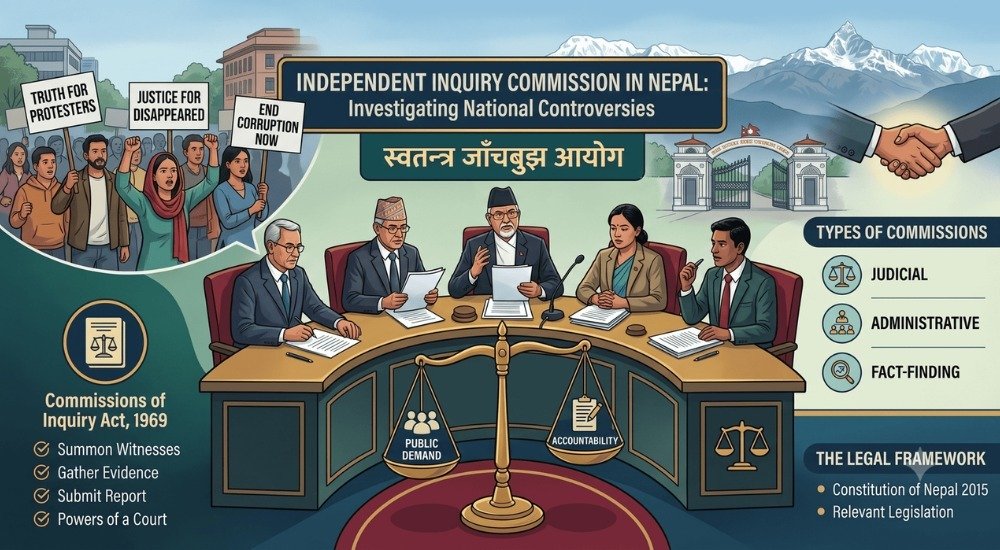
When a crisis strikes, whether it is a violent crackdown on protesters, credible allegations of large-scale corruption, or the disappearance of citizens during conflict the public demands answers. The government is expected to act, and one of the most visible responses available to it is the formation of an independent inquiry commission. These bodies have become a familiar feature of Nepal’s public life, appointed at moments of national controversy to investigate events or institutions that ordinary government machinery is seen as unable to examine fairly.
This article explains the legal framework governing independent inquiry commissions in Nepal, the different types that exist, who can form them, the procedure by which they are constituted, and how their powers compare to those of a court of law. It draws on the Constitution of Nepal 2015, the Commissions of Inquiry Act, 2026 (1969), and other relevant legislation, and illustrates the principles through three real examples.
The Legal Framework: Three Types of Independent Commissions
Not all independent commissions in Nepal are created equally. They fall into three broad categories, each resting on a different legal foundation.
Constitutional commissions
Constitutional commissions are established by the Constitution of Nepal 2015 itself. They exist permanently, derive their mandate directly from the constitution, and can only be abolished or fundamentally changed by amending the constitution. The Commission for the Investigation of Abuse of Authority (CIAA), established under Article 238 of the Constitution of Nepal 2015, is the clearest example. It investigates corruption and abuse of authority by public office holders. Other constitutional bodies include the National Human Rights Commission (Article 248), the Election Commission (Article 245), and the National Women Commission (Article 252).
Statutory commissions
Statutory commissions are created by an Act of Parliament for a specific, defined purpose and continue to operate for as long as that Act remains in force. The Truth and Reconciliation Commission (TRC) and the Commission on Investigation of Enforced Disappeared Persons (CIEDP) fall into this category, having been established under the Enforced Disappearances Enquiry, Truth and Reconciliation Commission Act, 2071 (2014). These bodies were created in response to the human rights violations of Nepal's decade-long armed conflict and were given specific mandates to investigate, record, and recommend remedies.
Executive inquiry commissions
Executive inquiry commissions are the most common and the most ad hoc. They are formed by the Government of Nepal, acting through the Council of Ministers, under the authority of the Commissions of Inquiry Act, 2026 (1969). They are temporary bodies, created for a defined purpose and a defined period, and they dissolve once they submit their report or once that period expires. The Karki Commission of 2025 is a recent example. The Rayamajhi Commission of 2006, which investigated killings during Jana Andolan II, is another.
Understanding which category, a commission belongs to matters, because it determines who created it, how it is governed, and what legal weight its findings carry.
Why Are Independent Inquiry Commissions Formed?
The reasons the government forms an inquiry commission rather than relying on the ordinary police, courts, or administrative machinery are both practical and political.
Perceived independence
Ordinary investigative agencies such as the Nepal Police or the Attorney General's Office are part of the executive branch. When the government itself is implicated in the events being investigated as is often the case in mass protest crackdowns or corruption scandals there is a legitimate concern that these agencies cannot investigate impartially. A commission with an independent membership, often drawn from the judiciary or retired public service, is intended to address that concern.
Fact-finding rather than prosecution
A commission is primarily a fact-finding body. Its purpose is to establish what happened, identify the causes, and make recommendations. It is not a court and does not convict anyone. This makes it suited to situations where the priority is public accountability and policy reform rather than immediate criminal sanction.
Specialised inquiry
Some matters require expertise that ordinary state machinery does not routinely have. A commission can include members selected for their specific knowledge retired judges, former police officers, lawyers, human rights experts assembled specifically for the task at hand.
Political legitimacy
Forming a commission is also a visible political response to public pressure. When citizens demand answers and accountability, appointing a prominent former judge to lead an inquiry signal that the government takes the matter seriously. This political dimension is openly recognised in practice, even if it also generates criticism when commissions are seen as devices for delaying genuine accountability.
Who Forms Them?
For constitutional commissions, the Constitution itself is the founding instrument. Appointments are made by the President on the recommendation of the Constitutional Council under Article 239 of the Constitution of Nepal 2015, following prescribed eligibility criteria including a minimum of twenty years of relevant experience.
For statutory commissions, Parliament creates the enabling act and the government constitutes the commission in accordance with that Act’s requirements on membership and qualifications.
For executive inquiry commissions, authority rests with the Council of Ministers acting under Section 3(2) of the Commissions of Inquiry Act, 2026 (1969). No parliamentary approval is required. The Cabinet decides, and the decision is formalised by publication in the Nepal Gazette under Section 3(3) of the same Act. Where the commission includes a sitting or retired judge, Section 3(1) requires the government to consult the Judicial Council before making the designation
How Is a Commission Formed? The Legal Procedure
The formation of an executive inquiry commission under the Commissions of Inquiry Act, 2026 (1969) follows this sequence.
The Cabinet takes a decision to form the commission, identifying the subject matter, the members, the chairperson, and the reporting deadline. A notice is then published in the Nepal Gazette under Section 3(3) of the Commissions of Inquiry Act, 2026 (1969). This gazette notice is the founding legal document: it defines the mandate precisely, and the commission has no authority beyond what the notice specifies.
Under Section 4(1), the commission’s functions are limited to those set out in the notice. It must complete its inquiry and submit a report, accompanied by its opinion, to the Government of Nepal within the specified period under Section 4(2). Where it cannot do so, Section 4(2a) allows the government to extend the period on the commission’s request with reasons given.
Once the report is submitted, Section 7 provides that the commission is automatically dissolved. The government may also dissolve it earlier by gazette notification if there is reasonable ground to believe the commission no longer serves any purpose.
Case Study: 1
The Karki Commission (2025 to 2026)
Background: On 8 and 9 September 2025, Gen Z-led protests against corruption and a government social media ban escalated into clashes that killed 76 people, injured over 2,500, and caused damage estimated at Rs 85 billion.
Legal Issue: What caused the violence, who bore responsibility, and what reforms were needed?
Decision: The Cabinet formed a three-member commission chaired by former Special Court judge Gauri Bahadur Karki, with a former Additional Inspector General of Police and a lawyer as members. After extensions, the commission submitted its 907-page report to Prime Minister Sushila Karki on 8 March 2026.
Case Study: 2
The Rayamajhi Commission (2006)
Background: Nepal’s Jana Andolan II of April 2006 involved security force action against protesters that resulted in deaths and injuries across the country. With the restoration of democracy, public demand for accountability was strong.
Legal Issue: Who ordered the use of force against protesters and who was responsible for the resulting deaths?
Decision: The government formed a commission chaired by former Chief Justice Krishnan Jung Rayamajhi. Its report named several officials as responsible for ordering the crackdown. The findings became material evidence in later Supreme Court proceedings: when the Supreme Court annulled the appointment of Lokman Singh Karki as Chief Commissioner of the CIAA, it noted the Rayamajhi Commission’s findings that Karki had been involved in suppressing Jana Andolan II.
The Truth and Reconciliation Commission (2015)
Background: Nepal’s armed conflict from 1996 to 2006 resulted in approximately thirteen thousand deaths and thousands of enforced disappearances. The 2006 Comprehensive Peace Agreement committed both sides to transitional justice mechanisms.
Legal Issue: How should Nepal investigate, acknowledge, and remedy the human rights violations of the conflict period?
Decision: Parliament enacted the Enforced Disappearances Enquiry, Truth and Reconciliation Commission Act, 2071 (2014), creating two statutory bodies: the TRC (Truth and Reconciliation Commission), to investigate gross violations and facilitate reconciliation, and the CIEDP (Commission on Investigation of Enforced Disappeared Persons), to investigate enforced disappearances specifically. Both were constituted in February 2015.
Conclusion
Independent inquiry commissions serve a genuine function in Nepal’s governance framework, providing a mechanism for structured, credible investigation when ordinary institutions cannot act impartially. The legal architecture is relatively coherent: constitutional commissions under the Constitution of Nepal 2015, statutory commissions under enabling Acts of Parliament, and executive inquiry commissions under the Commissions of Inquiry Act, 2026 (1969).
The practical limitation is equally clear. Advisory reports without implementation mechanisms mean that a commission’s value depends entirely on the political will of the government that receives its findings. Until a legal obligation is established requiring governments to formally respond to commission reports and to refer identified criminal conduct for prosecution these bodies will remain vulnerable to the charge that they serve process rather than accountability.

Ashaswi
Ashaswi Karki is an undergraduate law student passionate about making legal concepts accessible and engaging. Drawing on her academic journey and real-world experience with Nepal's legal system, she brings clarity and practical insights to her writing, helping readers better understand Nepali law.
View all postsGet the latest on laws and elections in your inbox.