Nepal’s Constitutional Council: Comparing the 2066 Act and the 2083 Ordinance

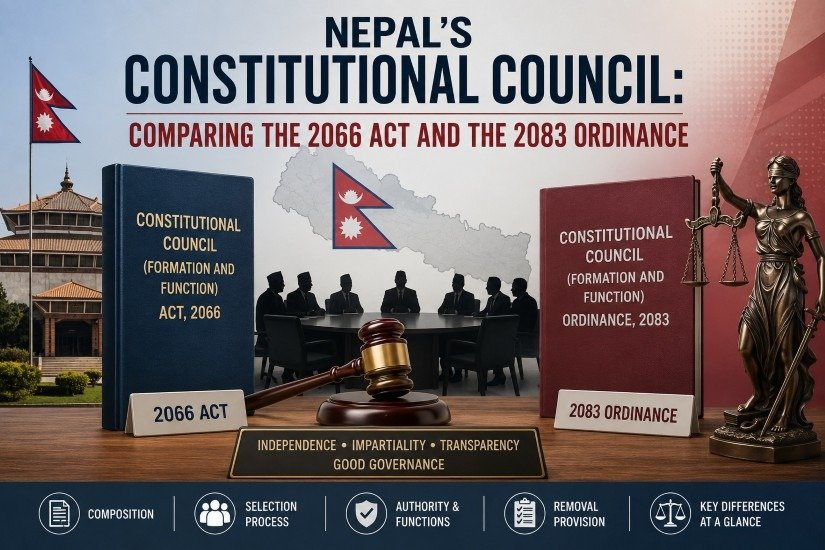
The Constitutional Council is a constitutional body established under Article 284 of the Constitution of Nepal (2072) which is responsible for recommending individuals for the appointment of key constitutional positions, including the Chief Justice and Chiefs and Officials of Constitutional Bodies. This Constitutional council and its activities are guided by a federal law named Constitutional Council Act, 2066.
Nepal’s government in Baisakh 2083, passed and brought ordinances, among which was an ordinance that changes certain provisions in the currently operational constitutional council’s laws This article aims to examine the legal foundations of Constitutional Council of Nepal and provides a comparative analysis of Constitutional Council Act 2066 and the new Constitutional Council (Functions, Duties, Power and Procedures) (First Amendment) Ordinance, 2083.
Legal Basis of Constitutional Council in Nepal
The constitutional and legal foundations governing the Constitutional Council in Nepal is established under the Constitution of Nepal (2072) and Constitutional Council Act, 2066.The new Constitutional Council (Functions, Duties, Power and Procedures) (First Amendment) Ordinance, 2083 came to amend section 6 and 7 of the 2066 Act.
1. The Constitutional Framework
Article 284 of Constitution of Nepal (2072) is the law which provides the formation of this Constitutional Council. The Council, as required by the constitution, works to recommend the Chief Justice and the heads and members of various Constitutional bodies, such as the CIAA, the Election Commission, the Public Service Commission etc.
Mandated Membership
The members that form the constitutional council is already written within the constitution of Nepal 2072, which requires a more complex process to bring changes as constitution is the supreme law of land and bringing changes within the constitution is different.
Article 284 lists six members for the Council.
- Prime Minister (Chairperson)
- Chief Justice (Member)
- Speaker of the House of Representatives (Member)
- Chairperson of the National Assembly (Member)
- Leader of the Opposition Party in the House of Representatives (Member)
- Deputy Speaker of the House of Representatives (Member)
2. Statutory Provision
Section 5 of the Constitutional Council (Functions, Duties, Powers, and Procedures) Act, 2066 (2010) requires the Council to give recommendation considering candidates based on their social prestige, high moral character, honesty, and professional experience. As per Section 8, the office of the Prime Minister and Council of Ministers performs the functions of the Secretariat of the Council.
3. Parliamentary hearings
The Constitutional Council recommends candidates, each of whom must undergo a public hearing by a 15-member joint committee of both the Houses of the Federal Parliament. Only after passing this hearing does a candidate become a final appointment by the President. This process ensures that the Council’s recommendations are subject to parliamentary accountability under Article 292 of the Constitution of Nepal 2072 B.S.
Comparative Analysis
The major changes brought by the new Constitutional Council (Functions, Duties, Power and Procedures) (First Amendment) Ordinance, 2083 in the Constitutional Council Act 2066 are mentioned below:
| Provisions | Act of 2066 | Ordinance of 2083 |
|---|---|---|
| Quorum [Section 6(4)] | Need of a chairperson and at least four other members to hold meeting. (Total of 5 out of 6) | Need of a chairperson and at least three other members to hold meeting. (Total of 4 out of 6) |
| Decision Making [Section 6(5)] | Requirement of unanimous consensus to make decision. | Decision can be made by a majority if consensus is not reached. |
| Recommendation [Section 7(2)] | No detail explanation on the process for sending names to the President. | The Secretary sends the name to the President’s Office immediately after the Parliamentary Hearing. |
| Added provision on Hearing Rejections [Section 7(3), 7(4)] | No provision | The Council must meet and recommend a new person immediately if the Parliamentary Hearing Committee rejects a name. |
Conclusion
Therefore, Nepal’s Constitutional Council now selects officials using a majority vote instead of requiring every member to agree. The 2083 Ordinance uses Article 114 and Section 6 to lower the number of members needed to hold a meeting and make a final decision. This new process helped fill the empty seats of the Chief Justice and sixteen commission leaders after a long delay. This system ensures that political disagreements do not stop the government from functioning.

Sahara
Sahara is a law student passionate about understanding how the law shapes institutions and governance in Nepal. Her academic journey has led her to analyse legal issues that are directly connected to the country's evolving political and institutional realities. She is committed to producing work that is legally accurate, clearly reasoned and accessible to a wider audience. She writes with the aim of contributing meaningfully to public understanding of the law and its vital role in shaping the country's governance.
View all postsGet the latest on laws and elections in your inbox.