
The gen-Z uprising that took place in 2082, Bhadra 23 and 24 led to the formation of a newly elected House of Representatives and a new government. However, the uprising resulted in the death of many students, personnel of Armed police force, media persons and many more. The subsequently formed interim government of Prime Minister Sushila Karki formed a commission popularly known as “Karki Commission” on the chairmanship of Gauri Bahadur Karki to investigate the facts that unravelled during the protest and to present a report to the government.
This article shall address the legal basis of the formation of the commission and the enforceability of the report so prepared by the commission. But before we dive into the provisions of the legal mandate that guides the formation of Investigation commissions like Karki Commission, the very first question that needs to be addressed would be “What is a commission?”
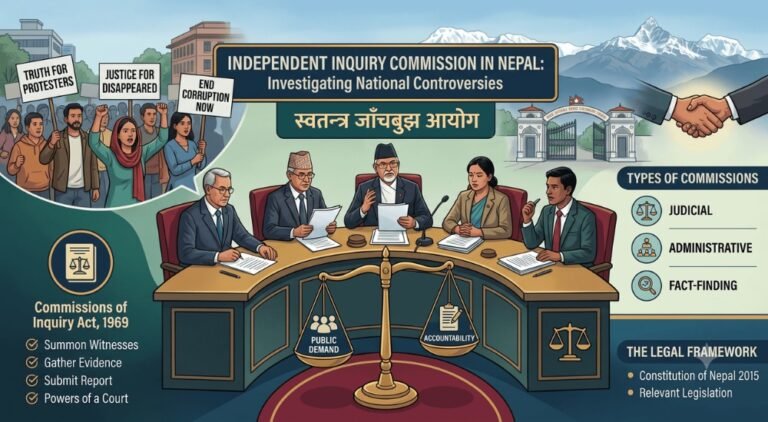
In simple words, a commission is a formal, independent body established by the government to investigate specific issues of public concern. Legally, it is an entity entrusted with the power to gather facts, examine evidence, and provide expert opinions to the state. According to the Investigation Commission Act, 2026, a commission is a tool for transparency, allowing the government to investigate “matters of public importance” that fall outside the daily scope of the judiciary or parliament.
Formation and Legal Basis
The formation of these bodies is governed by Investigation Commission Act, 2026 (1969) which has provisions that ensure they have the necessary legal framework to govern its procedure and to operate accordingly within the rule of law.
Governing Law
The specific legal foundation for such bodies is the Investigation Commission Act, 2026 (1969)
The Power to Form
Section 3(2) empowers the Government of Nepal to form an inquiry commission on matters of public interest
Karki Commission
After the Bhadra 23 & 24 unrest, the Council of Ministers officially formed the commission on 2082/06/05.
Public Notice Requirements
For a commission to be legally valid, its existence must be a matter of public record. Section 3(3) of the Investigation Commission Act, 2026 mandates that the government publish a formal notice in the Nepal Gazette (the official government journal).
- Specific Notice: The notice regarding the Karki Commission was published in the Nepal Gazette on 2082/06/05.
- Details Provided: This notice publicly declared the commission’s purpose, its members, and its initial three-month timeline, which formally began on 2082/06/09.
Member Qualifications and Legal Accountability
The law sets specific standards for the members of the commission so formed by the government based on the Commission of Investigation act, 2026 to ensure impartiality and expertise.
Qualifications
As per the legal framework enshrined within the Section 3(1) of the Act, government of Nepal consults with the judicial council for the appointment of Chief judge or judges from the Supreme Court, High Court, or District Court as members of the commission based on specific clause set forth in Article 132(1), Article 143(1) and Article150(1) of the Constitution of Nepal 2072, respectively.
However, the commission may also include judges only or other members besides the judges and if there are multiple members, the government designated judge would be the Chairperson.
Legal Status
Under Section 11, every member of the commission is classified as a “public servant.” This means they are subject to the same accountability and integrity laws as government officials, specifically the Corruption Prevention Act, 2059.
The Karki Commission Members
Chairperson
Gauri Bahadur KarkiFormer Chairperson, Special Court
Member
Bigyan Raj SharmaFormer Additional IGP
Member
Bisheshwar P. BhandariAdvocate - Criminal Investigation Expert
Jurisdiction: The Scope of Authority
Jurisdiction refers to the legal “boundary” within which the commission is allowed to act.
GENERAL MANDATE
The Investigation Commission Act, 2026 gives commissions the power to investigate “matters of public importance.
KARKI COMMISSION – SPECIFIC SCOPE
Casualties & damage on Bhadra 23–24 · Root causes of unrest · Future prevention recommendations
Conclusions and Recommendations of Karki Commission
After 5 months and 15 days of investigation, the commission primarily arrived at several key but not limited only to the following conclusions regarding the events:
- Findings on Causes: It identified the government’s ban on social media as the “immediate trigger,” while naming systemic corruption and poor governance as the “root causes” of public frustration.
- Assessment of Losses: The report documented significant human loss and extensive damage to government properties, including the Parliament building and local administrative offices.
- Core Recommendations: The commission proposed reforms in 17 sectors, including:
- Security: Creating clear Standard Operating Procedures (SOPs) for when and how security forces can use force.
- Justice: Removing “middlemen” from the legal system to ensure fair trials.
- Governance: Improving the transparency of public services to rebuild citizen trust.
Enforceability Under Federal Law
It is important to understand that an investigation commission is not a court of law. It does not hand down sentences or binding judgments. Instead, its power lies in its “opinion.”
- Under Section 4(2), the commission must submit its final report and opinions to the government.
- Section 8A mandates that the findings be published for the public, ensuring the government cannot simply ignore the results.
- While the recommendations are not automatically enforceable, they provide the official factual basis for the state to act. Once the report is submitted, the commission is dissolved (Section 7(1)), and the responsibility shifts to the government to implement the proposed changes through administrative or legal channels.
Conclusion
In a nutshell, commissions are formed by the government to address the matters of public importance that requires special attention and focus. It is primarily formed to ensure that enough light is shed on the contemporary issue of public focus to bring conclusions and answers through proper procedure and investigation.

Ashaswi
Ashaswi Karki is an undergraduate law student passionate about making legal concepts accessible and engaging. Drawing on her academic journey and real-world experience with Nepal's legal system, she brings clarity and practical insights to her writing, helping readers better understand Nepali law.
View all postsGet the latest on laws and elections in your inbox.