
Introduction
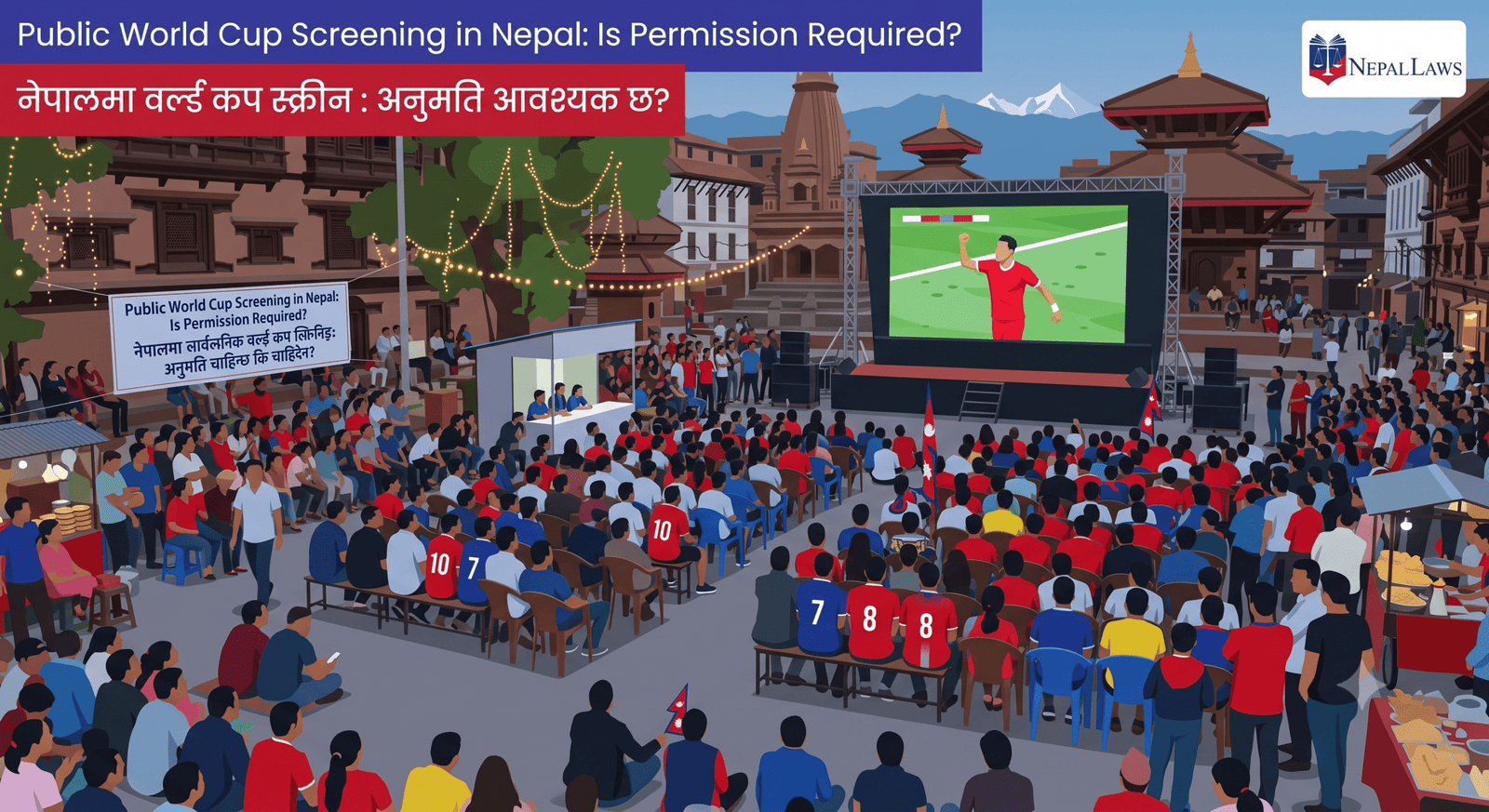
Football fever grips Nepal every four years when the FIFA World Cup comes around. Restaurants, hotels, clubs and community groups set up large screens in courtyards, car parks and open spaces. Crowds gather late into the night, cheering on their favourite teams. It feels spontaneous and celebratory, and for many organisers it does not feel like a legal exercise at all.
The reality is more complicated. Organising a public FIFA World Cup screening in Nepal involves at least three distinct areas of law: copyright, local government licensing and public order. Each creates a different kind of obligation, and the consequences of ignoring any of them can range from a formal warning to criminal prosecution. This article explains what the law requires, who you need to seek permission from, and what happens if you do not.
Copyright: Who Owns the Right to Broadcast
The broadcast as a protected work
A live football match broadcast is not simply a sporting event in the public domain. The audiovisual recording of each match, the broadcast signal, the commentary, the graphics and the associated production are all protected works under the Copyright Act 2059 (2002). Section 7 of that Act grants the copyright holder the exclusive economic right to broadcast the work through any medium and to communicate it to the public. Publicly screening a match without the rights holder’s permission is therefore a direct infringement of those economic rights.
Who holds the rights in Nepal
In Nepal, the exclusive broadcasting rights for the FIFA World Cup 2026 were licensed by FIFA to domestic broadcasters, reportedly including Himalaya Television Network and associated entities. Any organisation that sets up a screen in a restaurant, hotel, open space or community venue and shows the match to an assembled audience is communicating that broadcast to the public, an act reserved exclusively to the rights holder under Section 7 of the Copyright Act 2059 (2002).
Independent rights of broadcasting organisations
Broadcasting organisations also hold independent rights. Under Section 23 of the Copyright Act 2059 (2002), broadcasting organisations established in Nepal or in a World Trade Organization member state hold rights in their broadcasts for 50 years from the year of first broadcast. Nepal acceded to the Berne Convention in January 2006 and has been a WTO member since April 2004, meaning FIFA’s rights and those of the licensed Nepali broadcaster are fully protected under both domestic law and Nepal’s international obligations.
What permission an organiser needs
In practical terms, an organiser wishing to screen matches in public must either obtain a sub-licence from the official Nepali rights holder or, for genuinely non-commercial community events, register through FIFA’s Public Viewing Portal at publicviewing.fifa.org. For commercial screenings where entry fees are charged or the event is used to drive revenue, separate commercial permission from the licensed broadcaster is required.
Penalties for copyright infringement
Failure to obtain the necessary copyright permission exposes an organiser to infringement proceedings under the Copyright Act 2059 (2002). A first offence attracts a fine of NPR 10,000 to NPR 100,000 plus up to six months’ imprisonment, together with damages payable to the rights holder. A repeat offence doubles the fine ceiling and increases the imprisonment term to up to one year. Cases are heard at the District Court under the Summary Procedures Act 2028 (1971), with a three-month limitation period running from the date the rights holder became aware of the infringement.
The District Administration Office Approval
The DAO's legal authority
The District Administration Office (DAO) operates under the Local Administration Act 2028 (1971) with broad powers to maintain public order and authorise activities that could affect peace and security. Any public gathering that draws a crowd and takes place in a commercially or residentially sensitive environment falls within this remit.
The mandatory notice for World Cup 2026
On 11 June 2026, the District Administration Office, Kathmandu, issued a formal notice making it mandatory for any organisation, institution or company wishing to screen FIFA World Cup 2026 matches in public to obtain prior written approval. No large-scale screening, particularly on giant screens at night, would be permitted without it.
Approval is granted following assessment of the venue, its security sensitivity and the organiser’s commitment to comply with attached conditions. The application form is available on the DAO’s official website. Similar requirements apply in other districts, where the relevant DAO may issue corresponding notices.
Consequences of ignoring the DAO requirement
The DAO’s notice was explicit that gathering crowds under the pretext of a live match broadcast and engaging in unruly or unlawful activities would invite immediate legal action under prevailing laws. A DAO approval is not a formality: it is a binding prior condition.
Local Government and Municipal Requirements
Under the Local Government Operation Act 2074 (2017), local governments have authority to regulate entertainment activities, grant entertainment licences and impose entertainment tax within their jurisdiction. Schedule 8 of that Act confers these powers on municipalities and metropolitan cities.
A business operating within Kathmandu Metropolitan City may require both a DAO approval and a municipal entertainment licence for recurring or commercial screenings. For one-off community events in public spaces, the ward office may need to be notified where the event involves temporary structures, amplified sound or a large public assembly.
Organisers running commercial events at which entry fees are charged should seek specific advice on whether entertainment tax registration and payment obligations apply in their municipality under the Local Government Operation Act 2074 (2017).
Police Notification and Public Order
The criminal law framework
Under the National Penal Code 2074 (2017), conduct that disturbs public order, causes unnecessary obstruction or provokes unruly behaviour at a public gathering is a criminal offence. For any large event, it is standard practice to notify the nearest police station in advance and agree conditions on crowd management, noise and access.
Nepal Police instructions for the World Cup 2026
For the FIFA World Cup 2026, Nepal Police issued nationwide instructions focused on preventing illegal betting, online gambling and activities threatening public safety. Excessive noise, obstruction of roads and any connection to illegal gambling were all flagged for strict enforcement action.
Nepal Police have authority to intervene under the Public Offences and Penalties Act 2027 (1970) where a gathering becomes unruly, regardless of whether DAO permission is in place. Holding all necessary permits does not insulate an organiser from police intervention if the event itself causes a disturbance.
Consequences of non-compliance

Copyright enforcement
The licensed broadcaster can bring a criminal complaint at the District Court within three months of discovering the infringement, seeking a fine of NPR 10,000 to NPR 100,000, up to six months’ imprisonment and damages under the Copyright Act 2059 (2002). A civil claim for injunction can run in parallel.
Administrative and public order enforcement
The DAO can stop the event and impose penalties under the Local Administration Act 2028 (1971). Nepal Police can intervene at any point under the Public Offences and Penalties Act 2027 (1970) and the National Penal Code 2074 (2017).
Enforcement extends to online platforms
During the FIFA World Cup 2026, the Nepal Telecommunications Authority (NTA) blocked 35 websites and applications from streaming matches without authorisation, acting under the Electronic Transactions Act 2063 (2006). This confirms that enforcement applies equally to online and digital distribution, not only physical public screenings.
Impact on business licences
For commercial operators such as restaurants and hotels, a record of these violations can affect business licences and the ability to obtain future entertainment permissions from the municipality.
Police Notification and Public Order
Organising a public FIFA World Cup screening in Nepal is entirely lawful, but it requires preparation across three distinct areas of law: copyright permission from the licensed broadcaster or through the FIFA Public Viewing Portal, prior approval from the District Administration Office, and advance notification to Nepal Police with appropriate crowd management in place.
These three requirements operate independently. Satisfying one does not satisfy the others. An organiser who holds FIFA Public Viewing Portal registration but has not obtained DAO approval remains exposed, and vice versa.
Anyone with questions about copyright licensing, entertainment licences or the conditions attached to a DAO permission should seek qualified legal advice before proceeding.