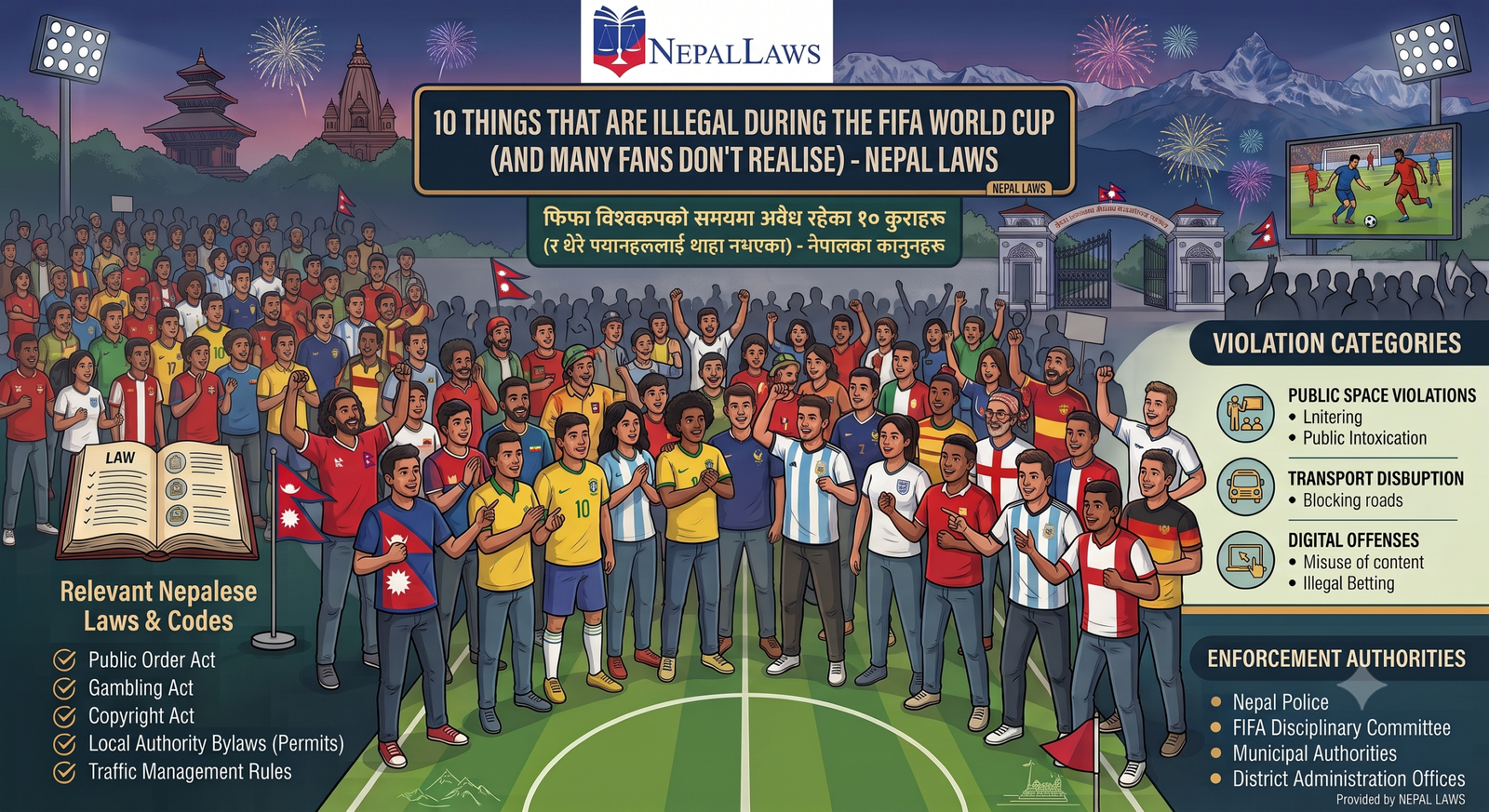

The 2026 Fédération Internationale de Football Association (FIFA) World Cup is in full swing across the United States, Canada, and Mexico, and if you think the drama is only on the pitch, think again. From constitutional vaping bans to federal agencies taping over ketchup bottles, the rules around this tournament go well beyond what most fans expect. Here are ten things that are genuinely illegal or heavily regulated during the World Cup, some of which have already caught people out.
1. FIFA literally covered Levi's Stadium's own name and, that is the law.
Here is something most fans attending the San Francisco Bay Area fixtures do not know: the stadium they are walking into is not actually called that. It is Levi’s Stadium, named after the denim brand, that paid $170 million for naming rights over ten years. For the duration of the World Cup, however, large white tapes cover the Levi’s branding both inside and outside the ground, and the venue has been temporarily renamed under FIFA’s instructions.
This is FIFA’s “clean stadium” policy in practice. Official sponsors pay up to $200 million for exclusive commercial rights over a four-year period, and those agreements prohibit any visible non-sponsor branding within the stadium perimeter. The obligation is contractual and enforceable. At Gillette Stadium in Foxborough, Massachusetts, crews applied nearly 65,000 individual strips of tape to conceal the brand name printed on every seat. Heinz ketchup bottles inside press areas were taped over. None of this was voluntary it was a condition of hosting.
2. Dutch fans had their trousers confiscated at the gate in 2006 and it could happen to you in 2026
At the 2006 World Cup in Germany, a group of Netherlands supporters arrived at their match wearing orange lederhosen handed out by Bavaria Beer. Budweiser was the official tournament beer sponsor. FIFA’s stewards asked the fans to remove the trousers before entering the stadium. They obliged, watched the match in their underwear, and the story went global.
That enforcement mechanism has not gone away. FIFA’s brand protection rules permit stadium security to require fans to remove, cover, or surrender items of clothing or accessories that visibly promote a brand competing with an official sponsor. This is not a casual preference; it is tied to the commercial exclusivity agreements that underpin the tournament’s entire financial structure. If you are wearing a shirt, cap, or accessory bearing the logo of a company that directly competes with a FIFA partner, you may be asked to deal with it before you get through the gate. Most fans have no idea this power exists.
3. Flying a drone near a stadium is a federal crime, and over 300 have already been seized
The Federal Aviation Administration (FAA) has designated all World Cup venues as official No Drone Zones. On match days, operating any unmanned aerial vehicle (UAV) within a 3-nautical-mile radius of a stadium without prior authorisation is a federal offence. Fan festival zones carry a 1-nautical-mile restriction.
The penalties are worth knowing before you pack. Civil fines reach $75,000 per violation. Criminal fines go up to $100,000, and courts can add a custodial sentence of up to one year on top of that. The FAA is monitoring airspace in active coordination with the Federal Bureau of Investigation (FBI) and the Transportation Security Administration (TSA). As of late June 2026, TSA Federal Air Marshals have already seized over 300 drones from people who assumed their device was too small, or that they were far enough away, to be a problem. In every single case, they were wrong.
4. Bringing a vape into Mexico is not just banned it is unconstitutional
On 16 January 2026, Mexico became the first country in the world to write a vaping ban directly into its constitution. Bringing e-cigarettes, vaping devices, or vaping liquids into the country is now illegal regardless of quantity, nicotine content, or whether they are for personal use. This applies at every port of entry, not just at the stadium.
Mexican customs officials are using X-ray scanning equipment to detect the lithium batteries inside vaping devices in both checked and carry-on luggage and they are finding them. A single device means confiscation and a fine. Multiple devices can be treated as an attempt to traffic prohibited goods, which carries considerably heavier consequences. If you are travelling to fixtures in Guadalajara or Mexico City, the device stays at home. Nicotine pouches are not currently covered by the constitutional ban and remain legal for personal use, which is the one practical workaround available to fans who need it.
5.Running onto the pitch in Texas is a criminal offence, not a funny stunt
Under Texas Penal Code Section 30.05, entering property without consent after being notified that entry is forbidden constitutes criminal trespass, classified as a Class B misdemeanour. The state must prove you entered and remained without consent which the stadium’s security measures and clearly marked boundaries establish automatically. This is not a stadium ejection and a lifetime ban. It is an arrest, a criminal charge, and a permanent record.
6. Immigration and Customs Enforcement agents are inside the stadiums, and arrests are not off the table
United States Department of Homeland Security (DHS) Secretary Markwayne Mullin confirmed in May 2026 that Immigration and Customs Enforcement (ICE) agents would be present at World Cup venues. The primary role described is event security, but the agency explicitly declined to rule out immigration enforcement action including arrests within or around the venues themselves.
Between January 2025 and October 2025, ICE made over 92,000 arrests across the eleven US cities now hosting World Cup fixtures. The American Civil Liberties Union (ACLU) has published specific guidance for World Cup attendees covering their rights at border crossings, domestic checkpoints, and in the vicinity of ICE activity. For fans from countries subject to heightened scrutiny at the US border, reading that guidance before departure and carrying appropriate documentation throughout your stay is not an overreaction it is sensible preparation.
7. The Department of Justice has already shut down nearly 400 illegal streaming sites during this tournament
The operation is called “Offsides,” and it is five times larger than the equivalent crackdown during the 2022 Qatar tournament. As of 29 June 2026, the United States Department of Justice (DOJ), coordinating internationally through the International Computer Hacking and Intellectual Property (ICHIP) Network, has seized nearly 400 domains used to broadcast World Cup matches without authorisation. Broadcasting rights are protected under United States copyright law, and the DOJ has confirmed that individual criminal prosecutions, not just platform takedowns, remain an active objective.
For most individual viewers, the legal risk is probably secondary to the cybersecurity risk. Unauthorised streaming platforms routinely install malware, harvest personal and financial data through unsecured connections, and expose users to fraud. The DOJ, FBI, and relevant cybersecurity agencies have all issued specific warnings about World Cup streams. The matches are on Fox and Telemundo in the United States, TSN and RDS in Canada, and ITV and BBC in the United Kingdom. There is no sensible reason to look anywhere else.
8. Reselling a ticket above face value is a criminal offence in several jurisdictions
Ticket scalping laws vary considerably across the three host nations, and fans often have no idea what the rules are in the specific city they are attending. In California, which is hosting fixtures in Los Angeles and San Francisco, reselling match tickets at or near a venue is a misdemeanour offence under state law. The Better Online Ticket Sales Act (BOTS Act), a federal statute, makes it unlawful to use automated means to bypass purchase limits and subsequently sell the inventory on, and that law covers all US host cities.
In Mexico City, reselling above face value in public areas is restricted under local consumer protection frameworks. In Ontario, Canada, the Ticket Sales Act regulates secondary market activity for events hosted in the province. FIFA’s only officially authorised resale channel is its own marketplace at FIFA.com/tickets. Tickets purchased anywhere else are not guaranteed to scan at the gate, and FIFA does not offer refunds or replacements when they do not. The FBI has separately warned fans about fraudulent websites impersonating FIFA’s ticketing portal and collecting banking information from people looking for last-minute deals. If the price looks too good, it almost certainly comes with a reason.
9. Leave the stadium during the match and you cannot come back in
This one catches people off guard at every tournament, and 2026 is no different. All World Cup venues operate a strict no re-entry policy. Once you exit the stadium perimeter, you are not permitted to re-enter for any reason, at any point during the event. There are no exceptions for accompanying a child, retrieving a forgotten item, or responding to a personal matter. Stadium staff have no discretion to make case-by-case exceptions.
Anything you might need for the duration of the match medication, personal items, documents need to be inside the venue with you from the start. The policy applies from the moment gates open and covers the full perimeter of the ground, not just the inner seating sections. It is not communicated as prominently as it should be, which is precisely why so many fans find out about it at the worst possible moment.
10. Using "FIFA World Cup" in your business promotion, without a licence, is a trademark violation
The phrase “FIFA World Cup,” the official tournament logo, the trophy image, and the tournament’s proprietary typeface are all registered intellectual property. Using any of them in commercial communications advertising, social media, promotional materials, or product packaging without an official FIFA licence infringes rights that are enforceable under the Lanham Act in the United States and under equivalent trademark legislation in Canada and Mexico.
FIFA’s brand protection teams are actively deployed across all three host nations throughout the tournament period. The irony is that the 2026 enforcement activity has repeatedly produced the opposite of the intended result. Levi’s turned a tarpaulin over its own logo into a viral global campaign. Heinz ketchup bottles with taped-over labels appeared in international press photographs. Masking tape on a footballer’s Beats headphones before a group stage match went viral within hours. Official World Cup sponsorships cost up to $200 million over four years. Not one of those brands paid a penny for that coverage FIFA’s enforcement handed it to them.
Additional note: Most of the world cup fans believe that friendly bets over the competition is completely off the legal framework. But “Friendly” prediction pool and betting by running informal cash-prize prediction groups on platforms like WhatsApp or Facebook, or using foreign betting apps (like 1xBet), is strictly illegal. For eg: In Nepal, even if the pot is just a few hundred rupees, the Nepal Police’s Cyber Bureau categorizes this as illegal gambling under the National Penal Code.
Conclusion
For the vast majority of fans attending the 2026 World Cup with valid documentation, lawful tickets, and no drone in their bag, none of this creates a practical problem. But the enforcement landscape around this tournament is more coordinated and more active than any previous edition. Federal agencies, FIFA’s brand protection teams, customs authorities, and immigration enforcement are all operating in the same spaces at the same time. Understanding the rules specific to the jurisdiction you are entering before you travel rather than at the gate is the kind of preparation that costs nothing and could save you a significant amount. The football is worth it. Finding yourself on the wrong side of a federal fine or a customs officer is not.