

The securities market holds a crucial position in Nepal’s economic landscape, serving as an engine for capital allocation that drives national growth and stability. This vibrant market, which encompasses a staggering 6.4 million active accounts, approximately 22% of the country’s population, has experienced remarkable growth. Such widespread participation fosters optimism among the audience about the market’s future expansion and potential.
Since its inception in 1993, the Securities Board of Nepal (SEBON) has been the primary regulatory authority. It has been dedicated to refining the legal framework governing the market, ensuring robust investor protection, and nurturing a climate of stability and trust. This ongoing commitment not only safeguards investors but also promotes a thriving investment environment, which is essential for fostering confidence in Nepal’s economic prospects. The evolution and strengthening of the securities market highlight Nepal’s significant contributions to its overarching economic development.
Historical Context and Development of Securities Regulation
Nepal’s securities market has developed over several decades. The regulatory landscape for the market began to take shape with the enactment of the Companies Act, 1936, which introduced basic provisions for the regulation of securities, including the publication of prospectuses and the transfer of shares. This historical context should instill respect for Nepal’s legal evolution and confidence in its regulatory foundations.
These early laws laid the foundation for securities regulation in Nepal, though more specific legislative frameworks did not emerge until later. In the 1960s, Nepal issued its first government bonds, followed by the establishment of the Nepal Securities Trading Centre (NSTS) in 1976, which marked the beginning of organised securities trading in the country.
Over the years, the government recognised the need for a more structured regulatory environment to facilitate the growth of the securities market. The introduction of the Securities Exchange Act of 1983 and the subsequent establishment of SEBON in 1993 marked a significant step in formalising securities market regulation. SEBON became the apex body responsible for overseeing market activities and ensuring that rules were in place to protect investors and promote fair trading practices.
Legal Framework on Securities Market in Nepal
The evolution of Nepal’s securities market has been strongly influenced by several pivotal pieces of legislation that have sculpted its regulatory landscape.
- Securities Act, 2063 - This Act provides the legal framework for the regulation of securities markets in Nepal, protecting investor interests and ensuring transparency in securities trading.
- Commodities Exchange Act, 2074 - This Act provides the legal framework for the regulation of securities markets in Nepal, protecting investor interests and ensuring transparency in securities trading.
- Money Laundering Prevention Act, 2064 - Focuses on preventing money laundering, terrorist financing, and tax evasion, addressing fraudulent activities in financial markets.
- Specialised Investment Fund Regulation, 2075 - Provides the framework for establishing investment funds that pool capital for maximising returns for investors.
- Securities Listing and Trading Rules, 2075 - Governs the listing and trading of securities on the stock exchange and ensures compliance with SEBON regulations.
- Securities’ Central Depository Service Regulation, 2067 - Outlines the establishment of the Central Depository System (CDS), facilitating electronic securities transactions and clearing.
- Credit Rating Regulation 2068 – Mandates the rating of securities and assesses the creditworthiness of entities issuing securities.
- Mutual Fund Regulations, 2067 - Governs the operation and management of mutual funds, enabling investors to pool resources for collective investment.
- Securities Businessperson Regulations, 2064 - Defines the standards for licensing and regulation of brokers, securities dealers, and market makers in Nepal.
- Stock Exchange Operation Regulation, 2064 - Regulates the licensing and operations of stock exchanges in Nepal.
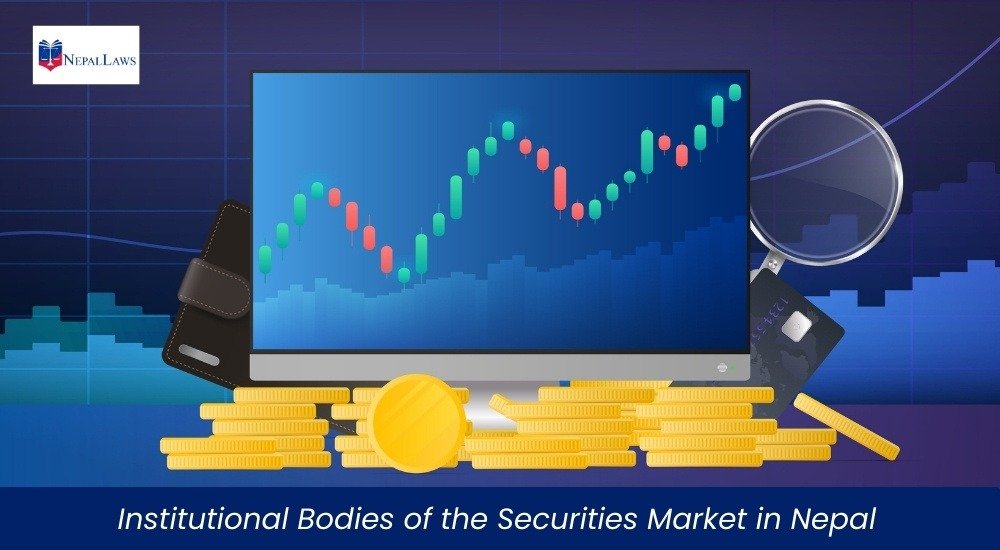
Institutional Bodies of the Securities Market in Nepal
For a securities market to operate effectively and efficiently, it is crucial to have robust institutional oversight. Several key regulatory bodies and institutions play a vital role in ensuring the integrity, transparency, and stability of the market. These institutions are responsible not only for enforcing rules and regulations but also for fostering investor confidence and promoting fair trading practices. Their combined efforts create a supportive framework that helps maintain a balanced marketplace and safeguards the interests of all participants.
Securities Board of Nepal (SEBON)
SEBON, formed in 1993, is the apex body for regulating Nepal’s securities market. It is responsible for overseeing the issuance and trading of securities, regulating market intermediaries, and promoting investor protection.
Nepal Stock Exchange (NEPSE)
NEPSE was established in 1993 and plays a crucial role in the trading of government and corporate securities. It helps facilitate market liquidity and price discovery for securities.
Office of the Company Registrar (OCR)
OCR is the principal body for registering companies in Nepal. Public companies are required to register their prospectuses with the OCR after obtaining SEBON approval.
Nepal Rastra Bank (NRB)
The NRB, Nepal’s central bank, oversees the financial sector, including the regulation of bank and financial institution (BFIs) securities. It ensures these institutions comply with regulatory requirements for financial instruments.
Judicial Interpretation of Securities Regulation
Nepal’s judiciary plays a crucial role in interpreting and enforcing securities regulations, serving as a guardian of the legal framework governing financial markets. Through a series of judicial decisions, the courts have not only clarified the roles and responsibilities of various regulatory bodies but also established important precedents that guide the resolution of securities-related disputes.
This dynamic interaction between the judiciary and regulatory authorities reinforces the rule of law in the financial sector, ensuring that investors and market participants can operate in a stable, predictable environment.
For example, in the Rajan Adhikari vs. Office of P.M. and Others (D.No 8234) case, the court upheld SEBON and NEPSE’s authority in regulating stockbroker licenses, affirming that judicial review is not applicable in such matters. Similarly, in Nepal Stock Exchange Limited vs. CIAA (NKP 2066, D.N. 8235), the court ruled that other bodies like the CIAA cannot overrule SEBON’s decisions regarding stockbroker licensing.
Challenges in the Securities Market Regulation
The securities market regulations encounter several significant challenges that impact their effectiveness.
These challenges include the complexity of regulatory frameworks, which can lead to confusion among market participants, the rapid pace of technological advancements, which often outstrip existing regulations, and the need for international coordination, as securities markets are increasingly interconnected globally.
Additionally, ensuring compliance and enforcement poses difficulties, as resources may be limited and the evolving nature of financial products complicates oversight. Addressing these challenges is crucial for maintaining market integrity, protecting investors, and fostering a stable economic environment.
Despite a robust legal framework, enforcement remains a significant challenge. The market suffers from weak regulatory implementation, which compromises investor confidence. Furthermore, Nepal’s securities laws have not fully incorporated provisions on foreign and portfolio investment, leaving gaps in the legal framework.
There is overlap between SEBON, the NRB, and the OCR, resulting in inefficiencies and delays. This institutional overlap can hinder the market’s smooth functioning.
The lack of skilled professionals within SEBON and other regulatory bodies has made it difficult to maintain comprehensive market oversight. This is particularly challenging as the market grows and becomes more complex.
While the regulatory framework has evolved, many investors still lack an understanding of securities products, regulations, and risks. This gap in financial literacy has impeded broader market participation and investor protection.
Conclusion
Nepal’s securities market is crucial for economic growth, but it remains underdeveloped in certain areas. While SEBON has made significant strides in regulating the market, legal gaps, weak enforcement, and technical deficiencies continue to pose challenges. The securities market must adapt to meet international standards and attract foreign investment.
Therefore, it is essential to reform existing laws, enhance institutional capacity, and introduce modern market practices to ensure the market’s stability and growth. To create a thriving and efficient securities market, regulators, policymakers, and investors must work together to reform Nepal’s securities laws.
By upgrading the legal framework, improving enforcement, and promoting investor education, Nepal can build a more secure and prosperous market. Investors are encouraged to stay informed about the regulatory environment and to engage with financial professionals to navigate this dynamic market actively.