The Procedure of Constitutional Amendment in Nepal: Roles of the HoR and NA

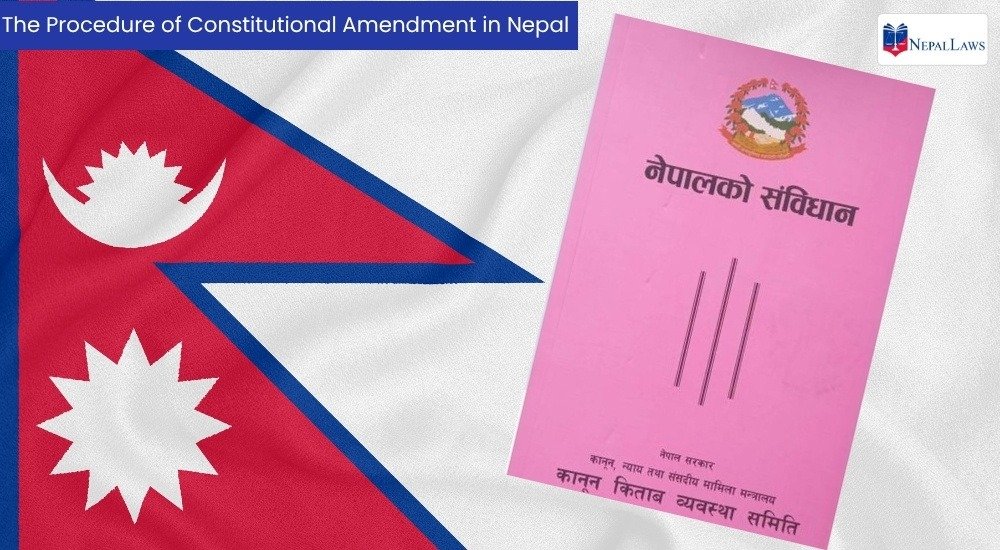
The process of amending the constitution in Nepal is a structured legal procedure that requires broad agreement among members of parliament. Both the House of Representatives and the National Assembly play essential roles in this process. The primary legal basis for constitutional amendments is found in Article 274 of the Constitution of Nepal 2072, along with the internal regulations of the House of Representatives Regulations (2079) and the National Assembly Regulations, (2080).
1. Scope and Limits of Constitutional Amendments
A constitutional amendment must always be introduced in the Federal Parliament (either in the House of Representatives or the National Assembly) in the form of a legislative bill.
A bill is a written draft that proposes a new law or a change to the constitution. It is the starting point for all laws. If any lawmaker wants to introduce a new idea, policy, or change, they must submit it to the parliament as a bill for review, discussion, and voting. When lawmakers want to change the constitution, they must present a special type of bill called a “constitutional amendment bill”.
However, there are limitations on what can be amended. According to Article 274, Clause (1) of Constitution of Nepal 2072, no amendment shall be made that is prejudicial to the followings:
- The Sovereignty of Nepal,
- The Territorial Integrity of Nepal,
- The Independence of Nepal,
- The Sovereignty vested in the people of Nepal,
After a bill is introduced, members may only propose amendments that are consistent with the main objectives of the bill, are clearly articulated, and pertain to the same sections of the Constitution addressed by the bill.
2. Proposal and Nature of the Bill
Who Can Propose:
Article 274(1) of Constitution of Nepal 2072 talks about the capacity of the proposer. According to the constitution, any member of the House of Representatives or the National Assembly may propose a constitutional amendment bill.
Classification of the Bill
Rule 92 of the National Assembly Regulations, 2080 provides that there are two kinds of bill, and the proposed bill falls into one of the two categories based on the proposer:
- Government Bill: This type of bill is introduced by the government (formally proposed by a Minister). This requires a prior notice of 5 days before it can be presented.
- Non-Government Bill: This type of bill is introduced by any regular member of parliament (not minister). This requires a prior notice of 7 days before it can be presented
3. Publication and Presentation of the Bill
Once a constitutional amendment bill is formally received, it undergoes a public notification process before parliamentary deliberation begins.
Mandatory Publication (30 Days)
The Secretary General or Secretary of the respective house must ensure the bill is made public within thirty days after it is presented.
Condition Where Publication is NOT Necessary
If a constitutional amendment bill originates in one house and is passed there, then sent to the other house with a formal message, the receiving house is not required to publish it again.
Presentation Timeline (7 Days)
Once published, the bill cannot be debated immediately. It can only be formally presented in an assembly meeting after 7 days have passed since the date of publication.
4. The Role of Provincial Assemblies, Schedule-6, and Mandatory Timeframes
Article 274(4) of the Constitution of Nepal 2072 has provided conditions about the amendment of matters related to provinces wherein, if a constitutional amendment bill proposes to change provincial boundaries or addresses topics listed in Schedule-6 of the Constitution, the specified province must be included in the decision-making process.
Matters under Schedule-6 (Provincial Jurisdiction)
According to the Constitution of Nepal 2072, Article 274 , if an amendment touches upon the exclusive powers of the provinces, provincial consent is required. These matters include, but are not limited to:
- Cooperatives, agriculture, health, and education/sports/newspapers.
- Services like electricity, drinking water, and irrigation.
- Service fees, penalties/fines, royalties from natural resources, and tourism fees.
- Forests, wildlife, environment, ecology, and biodiversity.
- Mines, minerals, and disaster management.
- Social security, poverty alleviation, squatter management, and vital statistics (birth, death, marriage).
- Archaeology, ancient monuments, and museums.
5. The Inter-House and Provincial Procedure
Seeking Consent (30 Days)
The bill must be sent to the Provincial Assembly to obtain their consent within 30 days of being presented in the federal house.
Exemption for the Second House
If the bill was first presented in the House of Representatives and provincial consent was already obtained, the National Assembly is not required to send it to the provinces again.
Provincial Veto Power
If a majority within the specific Provincial Assembly officially reject the bill within 3 months and notifies the federal assembly, the bill automatically becomes Once inactive, no further action will be taken on it in both federal houses.
What Happens if the Provincial Assembly Does Not Respond?
House of Representatives Regulations (2079) Rule 140(4) and National Assembly Regulations, 2080 Rule 129(4) states that, if the federal assembly does not receive any information or response from the Provincial Assembly within three months, the legislative process is not stalled. Once the period expires, the proposing member may present a proposal in the federal assembly (House of Representatives or National Assembly) requesting the bill to be considered.
6. Proposing Amendments and Clause-by-Clause Discussion
Once the House of Representatives or the National Assembly accepts the motion to consider the bill, the detailed review phase begins.
Strict Conditions for Member Amendments
Members of the respective house are allowed to propose their own amendments to the bill. However, any amendment proposed must be strictly limited only to the specific Article, Sub-article, Clause, Sub-clause, or Explanation that the original bill already targets for amendment.
Formation of a Special Committee
Under House of Representatives Regulations (2079) Rule 140(7) and National Assembly Regulations, 2080 Rule 129(7), to conduct a thorough clause-by-clause discussion on the constitutional amendment bill and its received amendments, the presiding officer (the Speaker in the HoR or the Chairperson in the NA) may form a Special Committee with the approval of the assembly to review the bill and prepare a report.
7. Voting Procedure and Required Majorities
The final passage of a constitutional amendment requires high consensus threshold and highly formalized voting procedures in both houses to ensure accountability.
Sequential Presentation
The Speaker or Chairperson must present each Article, Sub-article, and proposed amendment one by one to the assembly for a decision.
Method of Voting
The decision on the proposal to pass the constitutional amendment bill cannot be made by a simple voice vote. According to the National assembly regulations 2080, rule 129(10) it must be determined through a formal division of votes that includes the physical signatures of the voting members.
Required Majority (Exact Votes)
To be officially passed, the constitutional amendment bill must be approved by at least a two-thirds (2/3) majority of the total currently existing members of both assemblies.
- In the National Assembly: The Constitution sets the total composition of the NA at 59 members. Therefore, a two-thirds absolute majority requires at least 40 votes (assuming no vacant seats).
- In the House of Representatives: The Constitution sets the total composition of the House of Representatives at 275 members. Therefore, a two-thirds absolute majority requires at least 184 votes.
8. Execution of the Amendment
If both the House of Representatives and the National Assembly successfully pass the bill with their respective two-thirds majorities, they exchange formal messages to coordinate the passage. The finalized constitutional amendment bill is then certified by the presiding officers and sent to the President for final assent.
The President authenticates the bill within the constitutionally mandated 15-day period by signing it, the amendment then becomes an Act. The Secretary of the respective house is legally mandated to publish the notice of the President’s assent in the Assembly’s Notice Bulletin to make it public.
Conclusion
In a nutshell, Nepal’s process for changing the constitution follows clear steps and needs strong agreement from both houses of parliament. Provinces are involved when necessary, and changes only become law after careful review and a two-thirds majority vote in both houses, followed by the President’s approval. This system helps make sure that any changes are thoughtful and widely supported.

Ashaswi
Ashaswi Karki is an undergraduate law student passionate about making legal concepts accessible and engaging. Drawing on her academic journey and real-world experience with Nepal's legal system, she brings clarity and practical insights to her writing, helping readers better understand Nepali law.
View all postsGet the latest on laws and elections in your inbox.